ISO 9001 · EN 10204 3.1
Seamless Rolled Ring Manufacturer — OD up to 4000 mm
Ring rolling produces a seamless, circumferentially grained ring with no weld seam — stronger and more fatigue-resistant than a rolled-and-welded ring, and more economical than machining from solid plate.
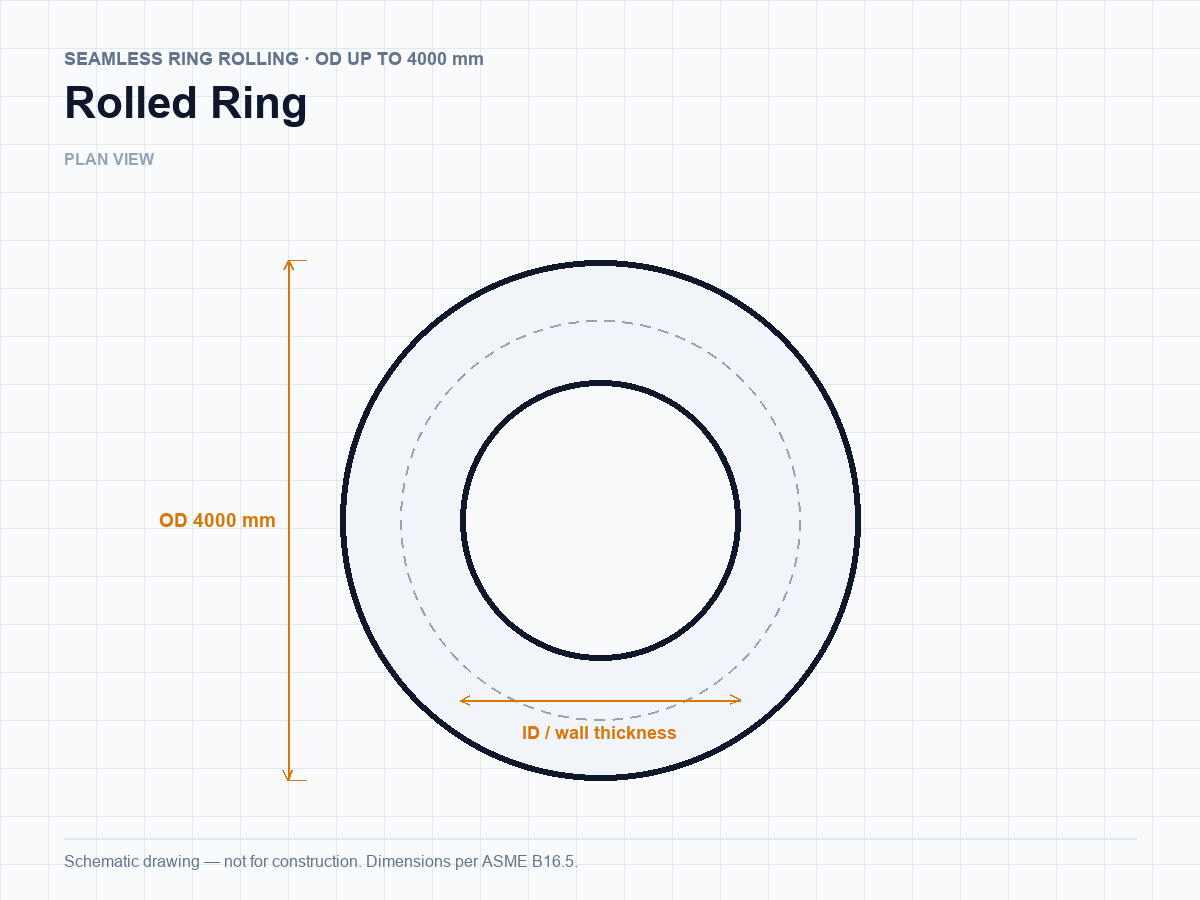
Process
Seamless ring rolling
OD range
200–4000 mm
Wall thickness
20–500 mm, depending on OD
Materials
Carbon, alloy, stainless, duplex
Profiles
Rectangular, tapered, near-net
Testing
UT, dimensional, mechanical
The ring rolling process starts with a pierced billet that is expanded between a driven roll and a mandrel. Material is displaced circumferentially, so the grain flows around the ring rather than across it. The result is a seamless part with consistent wall thickness, good concentricity and better hoop strength than a fabricated ring.
We roll rings from 200 mm to 4000 mm outside diameter, in carbon steel, alloy steel, stainless steel and duplex, with rectangular, tapered or near-net profiles. Rings are supplied normalized or quenched and tempered, with UT and dimensional reports. Typical uses include bearing races, gear blanks, wind-turbine flanges, valve bodies, pressure-vessel rings and large pipe flanges.
Key features
No weld seam
A rolled ring is seamless, eliminating the weld inspection and stress-relief steps required for fabricated rings.
Circumferential grain flow
Grain follows the hoop direction, which is exactly where tensile and fatigue stresses act in a bearing race or flange.
Near-net profile
Tapered and profiled rings reduce machining allowance and cut material waste on large parts.
Large diameter capability
Rings up to 4000 mm OD are rolled and heat treated in-house, with dimensional reports for each piece.
Typical applications
- Bearing races and slewing rings
- Gear blanks and clutches
- Wind-turbine tower and blade flanges
- Valve bodies and pressure-vessel rings
- Large pipe flanges and manway rings
- Crane and excavator slewing rings
Quality control & documentation
- UT after rolling and heat treatment
- Wall-thickness and concentricity checks
- Mechanical tests from a sacrificial test ring
- Hardness survey on the finished section
Material certificates to EN 10204 3.1 are issued with every shipment; third-party inspection (SGS, BV, TÜV) can be arranged on request.
Frequently asked questions
What is the advantage of a rolled ring over a welded ring?
A rolled ring is seamless and has circumferential grain flow, so it has no weld to inspect, no heat-affected zone and better fatigue performance. It also avoids the distortion that welding introduces in large rings.
Can you roll a ring with a non-rectangular section?
Yes — tapered, stepped and near-net profiles can be rolled with dedicated tooling. Send the section drawing and annual quantity so we can quote tooling and piece price.
Do you supply rings machined to final size?
We supply as-rolled, rough-machined or finish-machined rings. Finish machining is done after heat treatment to avoid distortion.
Request a quotation
Send your forged ring specification
Include the standard, size, pressure class, material, face type and quantity. Drawings are welcome — we will confirm feasibility, lead time and price within one business day.
- ★ Reply within 24 hours on business days
- ★ MTC 3.1 and dimensional report with every order
- ★ FOB, CIF and DDP terms available
Send an Inquiry
Send drawings, dimensions or a standard reference. Our sales engineers reply within 24 hours on business days.