ASME B16.5 · ASME B16.47
Weld Neck Flange Manufacturer — ASME B16.5, A105, Class 150–2500
Weld neck flanges are the default specification for high-pressure, high-temperature and cyclic-service piping because the tapered hub moves stress away from the weld and the butt weld can be fully radiographed.
Standard
ASME B16.5 / B16.47 A & B
Size range
1/2″–24″ (B16.5), 26″–60″ (B16.47)
Pressure class
150 / 300 / 600 / 900 / 1500 / 2500
Materials
A105, A350 LF2, A182 F304/F316, F11/F22/F91, 2205
Faces
RF, FF, RTJ
Finish
125–250 AARH, or per drawing
A weld neck flange (WN) connects to pipe with a single full-penetration butt weld. The long tapered hub transitions thickness gradually from the pipe wall to the flange ring, which lowers local stress concentration and improves fatigue life compared with slip-on or socket-weld designs. Because the bore matches the pipe schedule, there is no internal ledge for turbulence, erosion or crevice corrosion — a decisive advantage in wet sour service and in lines that are pigged or inspected by intelligent tools.
We machine weld neck flanges to ASME B16.5 (1/2″–24″) and ASME B16.47 Series A and B (26″–60″) in carbon steel, stainless steel, alloy steel and duplex grades. Standard pressure classes are 150, 300, 600, 900, 1500 and 2500 with raised face (RF), flat face (FF) and ring-type joint (RTJ) finishes. Every flange is supplied with a heat number stamped on the rim, a dimensioned inspection report and a 3.1 material certificate so the receiving engineer can trace the part back to the heat and the mechanical test results.
ASME B16.5 dimensions — Class 150 and 300
All values in millimetres (inch equivalent in brackets). Wall thickness, bore and hub are machined to the ordered standard. Size-specific pages include the full dimensional record for that size and class.
Class 150 weld neck flange
| Size | OD | Thickness | RF Ø | Bolt circle | Bolts | Approx. weight | |
|---|---|---|---|---|---|---|---|
| 2″ / DN50 | 152.4 mm (6″) | 17.5 mm (0.69″) | 91.95 mm (3.62″) | 120.6 mm (4.75″) | 4 × Ø19 mm | 2.7 kg (6 lb) | Details → |
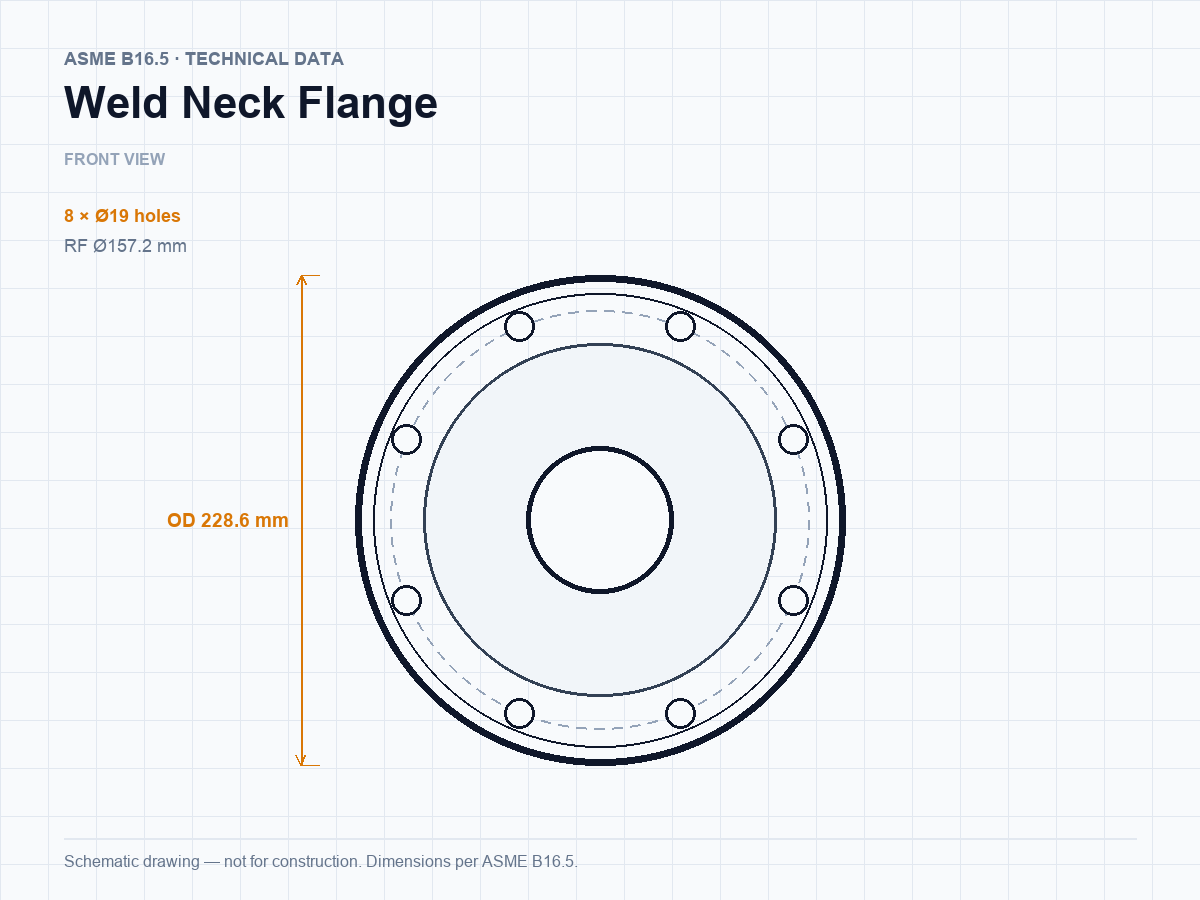
| 4″ / DN100 | 228.6 mm (9″) | 22.4 mm (0.88″) | 157.23 mm (6.19″) | 190.5 mm (7.5″) | 8 × Ø19 mm | 7.4 kg (16.3 lb) | Details → |
| 6″ / DN150 | 279.4 mm (11″) | 23.9 mm (0.94″) | 215.9 mm (8.5″) | 241.3 mm (9.5″) | 8 × Ø22.4 mm | 11.7 kg (25.8 lb) | Details → |
| 8″ / DN200 | 342.9 mm (13.5″) | 26.9 mm (1.06″) | 269.75 mm (10.62″) | 298.4 mm (11.75″) | 8 × Ø22.4 mm | 18.9 kg (41.7 lb) | Details → |
| 12″ / DN300 | 482.6 mm (19″) | 30.2 mm (1.19″) | 381 mm (15″) | 431.8 mm (17″) | 12 × Ø25.4 mm | 39.6 kg (87.3 lb) | Details → |
Class 300 weld neck flange
| Size | OD | Thickness | RF Ø | Bolt circle | Bolts | Approx. weight | |
|---|---|---|---|---|---|---|---|
| 2″ / DN50 | 165.1 mm (6.5″) | 20.8 mm (0.82″) | 91.95 mm (3.62″) | 127 mm (5″) | 8 × Ø19 mm | 4.1 kg (9 lb) | Details → |
| 4″ / DN100 | 254 mm (10″) | 30.2 mm (1.19″) | 157.23 mm (6.19″) | 200.2 mm (7.88″) | 8 × Ø22.4 mm | 11.9 kg (26.2 lb) | Details → |
| 6″ / DN150 | 317.5 mm (12.5″) | 35.1 mm (1.38″) | 215.9 mm (8.5″) | 269.7 mm (10.62″) | 12 × Ø22.4 mm | 20.3 kg (44.8 lb) | Details → |
| 8″ / DN200 | 381 mm (15″) | 39.6 mm (1.56″) | 269.75 mm (10.62″) | 330.2 mm (13″) | 12 × Ø25.4 mm | 31.1 kg (68.6 lb) | Details → |
| 12″ / DN300 | 520.7 mm (20.5″) | 49.3 mm (1.94″) | 381 mm (15″) | 450.8 mm (17.75″) | 16 × Ø31.8 mm | 63.9 kg (140.9 lb) | Details → |
Need Class 600–2500, RTJ faces or sizes above 12″? Send the size and class and we will return a dimensioned drawing and price the same day.
Key features
Butt-weld geometry that passes RT
Hub bore, bevel angle and root face are machined to B16.5 so the joint can be radiographed or ultrasonically tested without rework. Pipe schedule matched on request.
Traceability by heat number
Heat number, grade and size are stamped on the rim. MTC 3.1, PMI report and dimensional record are filed against the same heat.
High-temperature service
A105 covers Group 1.1 carbon steel up to 425 °C; F11, F22 and F91 are stocked for refinery and power piping where creep strength matters.
Corrosion-resistant options
304/304L, 316/316L, 321, 347, duplex 2205 and super duplex 2507 are machined from forged rings, not plate, to keep through-thickness properties.
Typical applications
- Oil and gas transmission and gathering lines
- Refinery process piping and hydroprocessing units
- Steam and condensate systems in power plants
- Petrochemical and chemical reactors
- Offshore topsides and subsea manifolds
- Pipelines subject to pigging and in-line inspection
Quality control & documentation
- Chemical and mechanical tests per heat, reported on EN 10204 3.1 MTC
- 100% visual and dimensional inspection against B16.5 tables
- PMI on stainless and alloy heats to confirm grade
- UT or RT on request for critical service; MPI/PT on welds and faces
- Hydrostatic test per customer specification, with test pressure recorded
Material certificates to EN 10204 3.1 are issued with every shipment; third-party inspection (SGS, BV, TÜV) can be arranged on request.
Frequently asked questions
What is the difference between a weld neck and a slip-on flange?
A weld neck flange is butt-welded to the pipe through a tapered hub, so it handles higher pressure, temperature and cyclic load and can be fully radiographed. A slip-on flange slides over the pipe and is fillet-welded on both sides — cheaper and easier to align, but limited to lower-duty service.
Which material should I specify for a 300-class weld neck flange?
For non-corrosive service at ambient to moderate temperature, ASTM A105 is the standard choice. For low-temperature service down to −46 °C use A350 LF2; for corrosive or hygienic service use 304/316L; for refinery high-temperature hydrogen service consider F11, F22 or F91.
Can you supply flanges with a machined bore to match my pipe schedule?
Yes. Send the pipe specification (NPS, schedule, material) and we will machine the bore and bevel to match, so the internal diameter is flush with the pipe and the weld can be radiographed.
What is the typical lead time?
Standard sizes in A105 from stock ship in 7–15 days. Made-to-order sizes, alloy grades and RTJ faces typically take 20–30 days depending on quantity and testing requirements.
Request a quotation
Send your weld neck flange specification
Include the standard, size, pressure class, material, face type and quantity. Drawings are welcome — we will confirm feasibility, lead time and price within one business day.
- ★ Reply within 24 hours on business days
- ★ MTC 3.1 and dimensional report with every order
- ★ FOB, CIF and DDP terms available
Send an Inquiry
Send drawings, dimensions or a standard reference. Our sales engineers reply within 24 hours on business days.