ASME B16.5 · ASME B16.47
Blind Flange Manufacturer — ASME B16.5, Class 150–2500
Blind flanges close a pipe, valve or vessel opening and are designed to carry the full pressure load across an unsupported disc — the thickest and most highly stressed flange in any line class.
Standard
ASME B16.5 / B16.47 A & B
Size range
1/2″–24″ (B16.5), 26″–60″ (B16.47)
Pressure class
150 / 300 / 600 / 900 / 1500 / 2500
Materials
A105, A350 LF2, 304/316L, F11/F22, 2205
Faces
RF, FF, RTJ
Options
Tapped centre port, custom bolt pattern
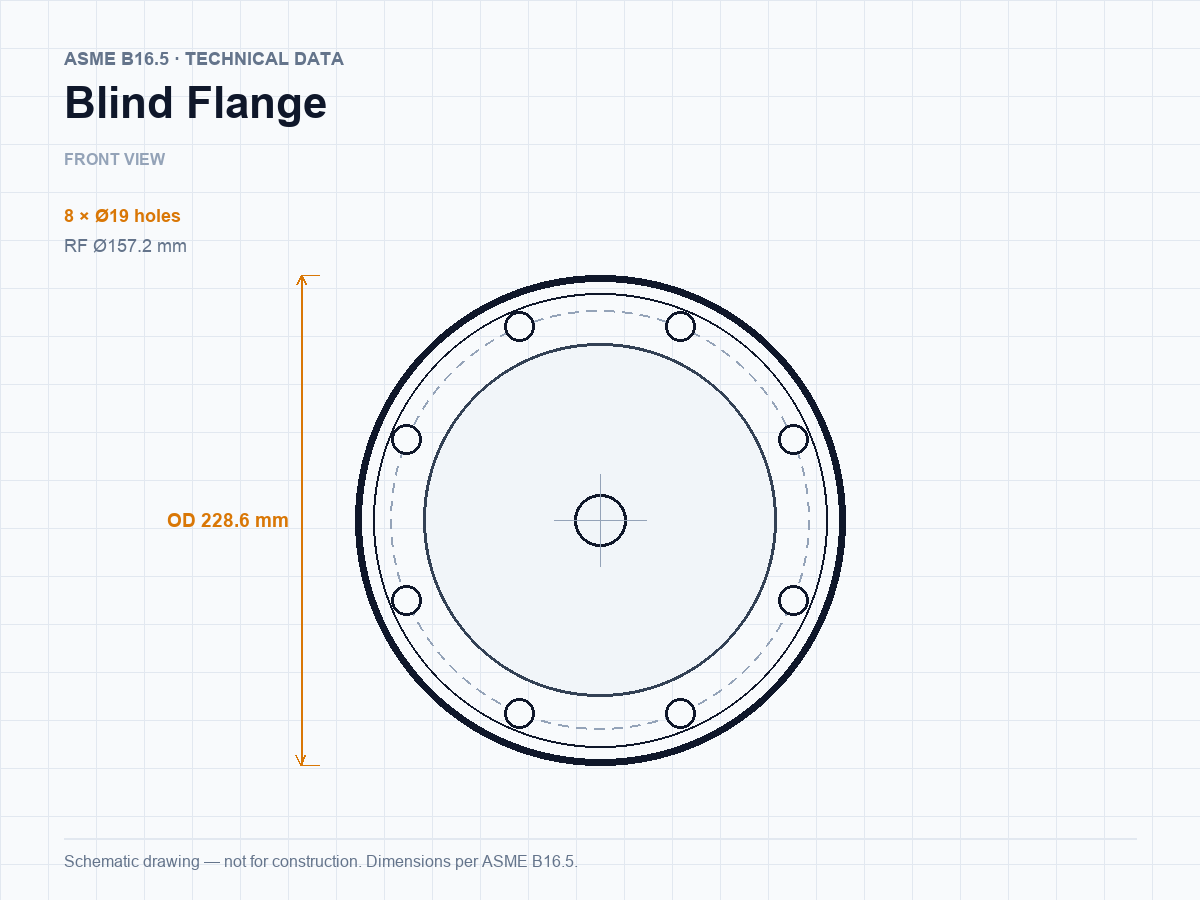
A blind flange (BL) is a solid disc with a bolt circle that mates to a standard flange. Because there is no bore, the plate must resist the full internal pressure in bending, so B16.5 specifies a thicker section than for a weld neck or slip-on flange of the same size and class. Blind flanges are used for line ends, vessel manways, test points, future tie-ins and temporary isolation during commissioning and turnaround.
We machine blind flanges to B16.5 in A105, A350 LF2, 304/304L, 316/316L, F11/F22 and duplex, with RF, FF or RTJ faces. Each disc is checked for thickness, flatness, bolt-hole spacing and face finish, and can be supplied drilled to a non-standard bolt pattern or with a tapped centre port for pressure testing. For large-diameter closures we also produce B16.47 Series A and B blinds up to 60″.
ASME B16.5 dimensions — Class 150 and 300
All values in millimetres (inch equivalent in brackets). Wall thickness, bore and hub are machined to the ordered standard. Size-specific pages include the full dimensional record for that size and class.
Class 150 blind flange
| Size | OD | Thickness | RF Ø | Bolt circle | Bolts | Approx. weight | |
|---|---|---|---|---|---|---|---|
| 2″ / DN50 | 152.4 mm (6″) | 19 mm (0.75″) | 92.1 mm (3.625″) | 120.6 mm (4.75″) | 4 × Ø19 mm | 1.36 kg (3 lb) | Details → |
| 4″ / DN100 | 228.6 mm (9″) | 23.8 mm (0.938″) | 157.2 mm (6.188″) | 190.5 mm (7.5″) | 8 × Ø19 mm | 7.71 kg (17 lb) | Details → |
| 6″ / DN150 | 279.4 mm (11″) | 25.4 mm (1″) | 215.9 mm (8.5″) | 241.3 mm (9.5″) | 8 × Ø22.2 mm | 11.79 kg (26 lb) | Details → |
| 8″ / DN200 | 342.9 mm (13.5″) | 28.6 mm (1.125″) | 269.9 mm (10.625″) | 298.4 mm (11.75″) | 8 × Ø22.2 mm | 20.41 kg (45 lb) | Details → |
| 12″ / DN300 | 482.6 mm (19″) | 31.8 mm (1.25″) | 381 mm (15″) | 431.8 mm (17″) | 12 × Ø25.4 mm | 49.9 kg (110 lb) | Details → |
Class 300 blind flange
| Size | OD | Thickness | RF Ø | Bolt circle | Bolts | Approx. weight | |
|---|---|---|---|---|---|---|---|
| 2″ / DN50 | 165.1 mm (6.5″) | 22.2 mm (0.875″) | 92.1 mm (3.625″) | 127 mm (5″) | 8 × Ø19 mm | 3.63 kg (8 lb) | Details → |
| 4″ / DN100 | 254 mm (10″) | 31.8 mm (1.25″) | 157.2 mm (6.188″) | 200 mm (7.875″) | 8 × Ø22.2 mm | 12.25 kg (27 lb) | Details → |
| 6″ / DN150 | 317.5 mm (12.5″) | 36.5 mm (1.438″) | 215.9 mm (8.5″) | 269.9 mm (10.625″) | 12 × Ø22.2 mm | 22.68 kg (50 lb) | Details → |
| 8″ / DN200 | 381 mm (15″) | 41.3 mm (1.625″) | 269.9 mm (10.625″) | 330.2 mm (13″) | 12 × Ø25.4 mm | 36.74 kg (81 lb) | Details → |
| 12″ / DN300 | 520.7 mm (20.5″) | 50.8 mm (2″) | 381 mm (15″) | 450.8 mm (17.75″) | 16 × Ø31.8 mm | 83.46 kg (184 lb) | Details → |
Need Class 600–2500, RTJ faces or sizes above 12″? Send the size and class and we will return a dimensioned drawing and price the same day.
Key features
Full pressure rating
Thickness is selected from the B16.5 blind-flange table for the class and size, so the disc carries the rated pressure without a support.
Leak-tight isolation
Face finish and flatness are controlled to seat a spiral-wound or RTJ gasket, giving reliable isolation during maintenance and testing.
Test-point and tie-in options
Centre ports can be drilled and tapped (NPT or BSP) for pressure gauges, venting or hydrostatic testing, with the port size marked on the rim.
Large-diameter capability
B16.47 Series A and B blinds up to 60″ are machined on vertical lathes with dimensional reports for each part.
Typical applications
- Pipeline ends and future tie-in points
- Vessel manways and inspection openings
- Valve and pump isolation during maintenance
- Hydrostatic test closures
- Tank and separator openings
- Temporary blinding during turnaround
Quality control & documentation
- Thickness and flatness measured on every disc
- Bolt-hole pitch and diameter checked against the mating flange
- Face finish verified for the specified gasket type
- MTC 3.1 and heat-number stamping as standard
Material certificates to EN 10204 3.1 are issued with every shipment; third-party inspection (SGS, BV, TÜV) can be arranged on request.
Frequently asked questions
Why is a blind flange thicker than a weld neck flange?
A blind flange has no bore to relieve the pressure load, so the full pressure acts on an unsupported disc in bending. ASME B16.5 therefore specifies a thicker section for blinds than for flanges of the same size and class.
Can a blind flange be drilled and tapped?
Yes. We routinely machine a tapped centre port (NPT or BSP) for pressure testing, venting or gauge connection, and can add a blind boss or weld nipple if required.
What gasket should be used with an RTJ blind?
An RTJ blind needs a matching ring-type joint gasket (soft iron, 316L or other alloy) and a ring groove machined to the correct B16.5 profile. We machine the groove to the class and size and supply the matching gasket on request.
Request a quotation
Send your blind flange specification
Include the standard, size, pressure class, material, face type and quantity. Drawings are welcome — we will confirm feasibility, lead time and price within one business day.
- ★ Reply within 24 hours on business days
- ★ MTC 3.1 and dimensional report with every order
- ★ FOB, CIF and DDP terms available
Send an Inquiry
Send drawings, dimensions or a standard reference. Our sales engineers reply within 24 hours on business days.