ISO 9001 · EN 10204 3.1
Closed Die Forging Manufacturer — Custom Near-Net Parts
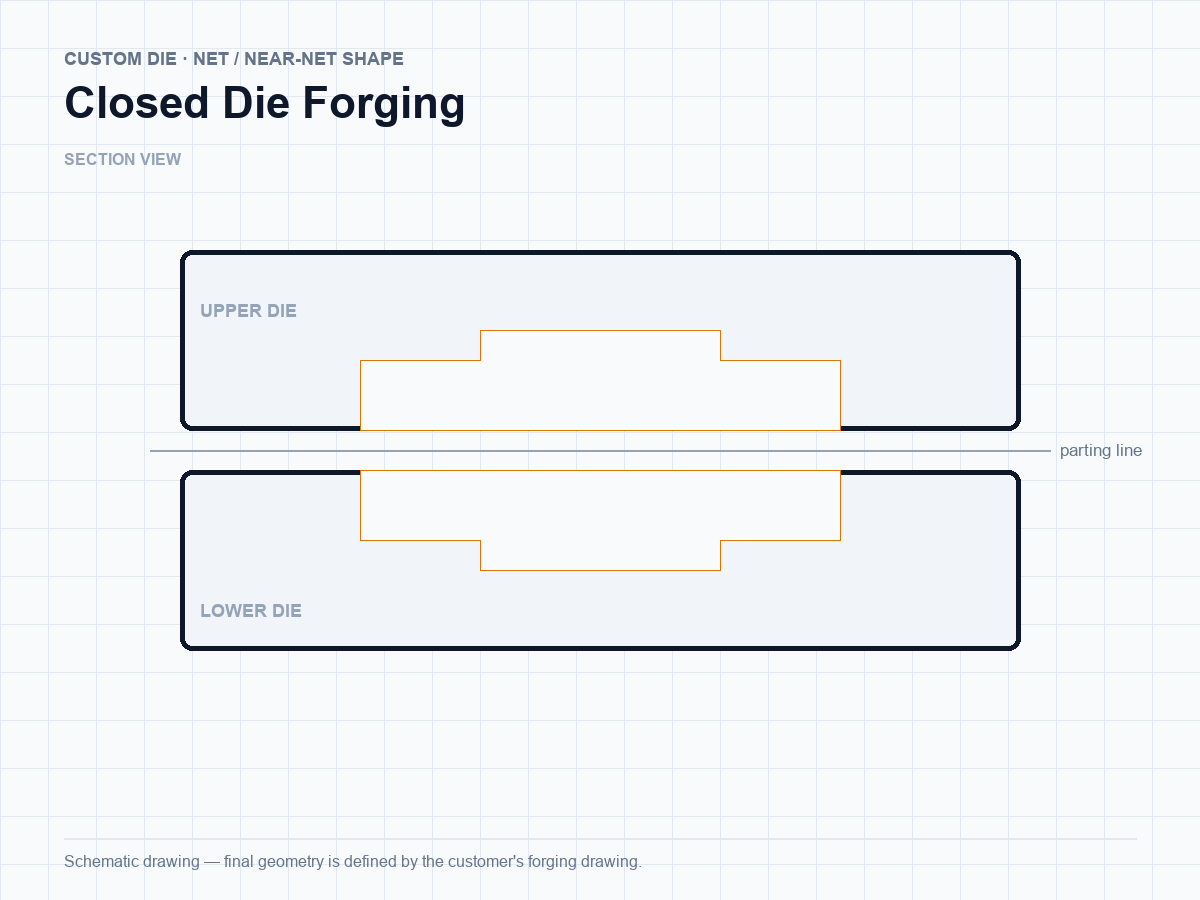
Closed-die forging turns a heated billet into a near-net shape between two machined dies, giving a part with continuous grain flow, predictable strength and far less machining than a cut-from-solid component.
Process
Closed-die / impression-die forging
Weight range
0.5–500 kg per piece
Materials
Carbon, alloy, stainless, duplex
Tolerance
DIN 7526 / customer drawing
Tooling
Die design and manufacture in-house
Finishing
Normalizing, Q&T, machining, coating
Closed-die (impression-die) forging is the process of choice for structural and load-bearing parts in moderate to high volumes: connecting rods, yokes, levers, brackets, valve bodies, flanges with special profiles and automotive steering and suspension components. The die cavity controls the shape, so the part is produced with a small machining allowance and consistent dimensions from piece to piece.
We forge parts from 0.5 kg to 500 kg in carbon steel, alloy steel, stainless steel and duplex, with die design, tooling manufacture, heat treatment, machining and inspection handled in one workflow. For new parts we review the drawing for draft angles, fillets, parting line and machining allowance, then produce a prototype for approval before the production run.
Key features
Near-net shape
The die cavity forms the part close to final geometry, cutting machining time and material waste.
Consistent grain flow
Material flows along the part contour rather than being cut through, improving strength and fatigue life at fillets and bosses.
Repeatable dimensions
A machined die produces the same part every cycle; critical dimensions are checked against the drawing at first article and at intervals.
Design-for-forging review
We check draft, fillets, parting line and machining allowance before cutting tooling, avoiding costly die changes later.
Typical applications
- Connecting rods and steering components
- Yokes, levers and brackets
- Valve bodies and pump housings
- Rail and truck suspension parts
- Agricultural implement components
- Industrial machine structural parts
Quality control & documentation
- First-article inspection before production
- Dimensional checks at agreed intervals
- Heat-treatment and hardness verification
- UT/MT on request for safety-critical parts
Material certificates to EN 10204 3.1 are issued with every shipment; third-party inspection (SGS, BV, TÜV) can be arranged on request.
Frequently asked questions
What volumes justify closed-die tooling?
Tooling usually pays back from a few hundred pieces upward, depending on part size and complexity. For prototypes or very low volumes, open-die or machined alternatives may be more economical.
How long does tooling take?
Typically 4–6 weeks for a new die set, plus 1–2 weeks for first-article samples. Existing dies can often be re-used for repeat orders.
Can you forge stainless steel parts?
Yes — 304/304L, 316/316L, 17-4PH and duplex grades are forged with controlled heating and cooling to preserve corrosion resistance.
Request a quotation
Send your die forging specification
Include the standard, size, pressure class, material, face type and quantity. Drawings are welcome — we will confirm feasibility, lead time and price within one business day.
- ★ Reply within 24 hours on business days
- ★ MTC 3.1 and dimensional report with every order
- ★ FOB, CIF and DDP terms available
Send an Inquiry
Send drawings, dimensions or a standard reference. Our sales engineers reply within 24 hours on business days.